B1 / B2 US tourist visa · interview coaching

Before your real visa interview,
practice with an AI interviewer

An AI interviewer, playing a consular officer, runs a realistic 214(b)-style mock interview on your own materials, finds every inconsistency across your form, spoken answers, and supporting documents, then shows you how to fix it. No form to finish first — three minutes of talking starts your first session.

Choose the simulation intensity
PARENTS VISITING FAMILY?
Start in Realistic mode with each parent’s real visit plan
First check each applicant’s DS-160, visit plan, and actual funding; then let each parent answer in their own words. New accounts receive one free credit — enough for both parents to sit one Realistic-mode interview each.
Read the parent-visit checklist ->
Application type: B1/B2 tourist visa · about 10 minutes

This product only offers mock interviews and document-consistency practice. It is not affiliated with the US government, does not provide legal advice, and does not guarantee any visa outcome.
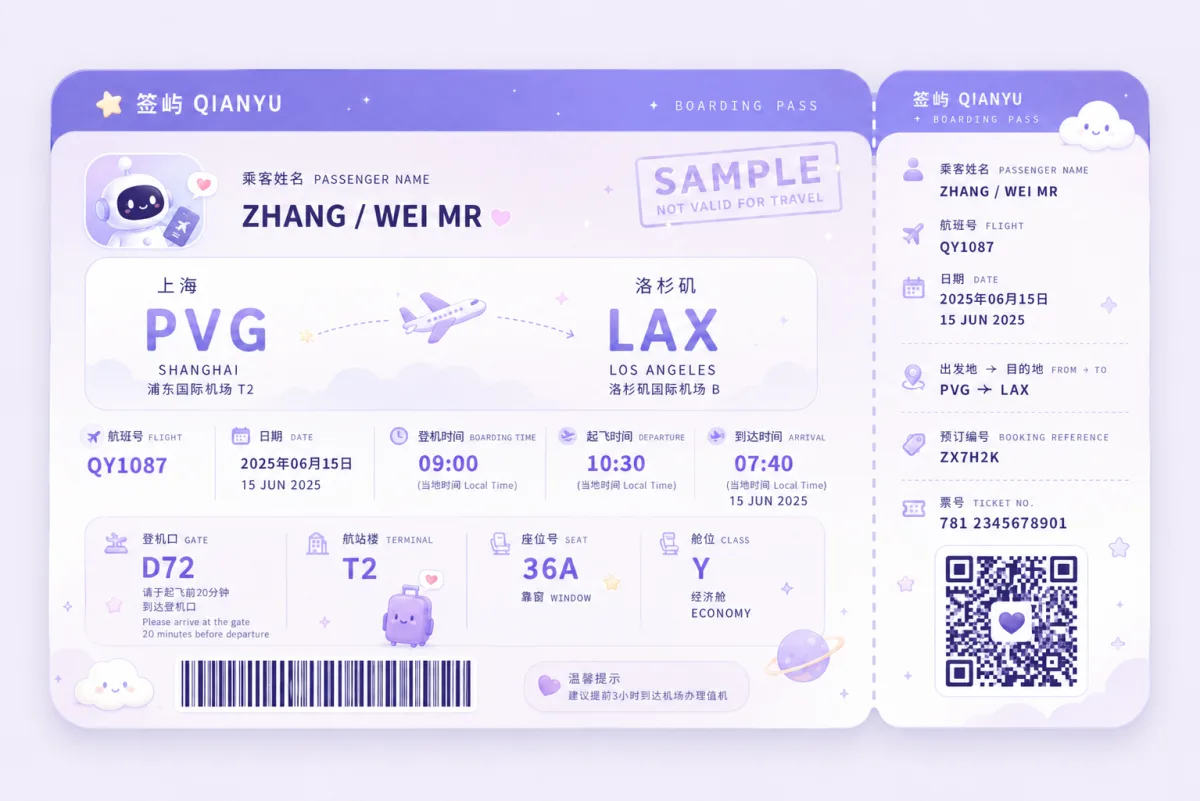

Hand-drawn boarding-pass illustration
Mock officer
Mock officer
Interview in progress
How long will you stay in the U.S.?
About two weeks.
Inconsistency: the DS-160 lists a 45-day stay, conflicting with the spoken “two weeks”.
214(b) riskMedium
Document consistency
9 items checked
// WHAT IS VISAISLE

What is VisaIsle

qianyu (签屿/VisaIsle) is an AI mock visa interviewer for the US B1/B2 visitor visa that reads your DS-160, cross-checks it against your spoken answers and supporting documents to catch every inconsistency, and drills you with realistic 214(b)-style consular questioning at three difficulty levels — with pay-as-you-go credit packs from ¥29.9 for Chinese applicants.

Unlike memorizing template answers, VisaIsle starts from your own DS-160: the AI reads the form first, then probes what you wrote in a live voice conversation and points out, on the spot, wherever the form, your spoken answers, and your documents disagree. Every session ends with a review report: a decision-style verdict, an item-by-item inconsistency list, an eight-dimension risk profile, and steadier phrasings to practice. Built for first-time applicants, parents visiting children in the US, short business trips, and applicants preparing a second attempt after a 214(b) refusal.

PRICING
Packs at ¥29.9 (1 training credit) / ¥59.9 (3 credits); new users get 1 free credit; credits never expire.
CREDITS
Realistic mode costs 0.5 credits · Training 1 · Stress 1.5 — deducted only once the voice call connects.
FLOW
Upload or dictate your DS-160 -> live voice interview -> on-the-spot verdict with an inconsistency list, about 10 minutes.
SCOPE
US B1/B2 visa only; an AI practice tool, unaffiliated with the US government or its consulates, no outcome guarantees.
Pricing & credits ->FAQ ->
VISAISLE // B1/B2Turn the interview into one well-prepared trip
QY-160BOARDING PASS

Document consistency check

Cross-checks your DS-160, spoken answers, and supporting documents to catch every contradiction.

DOCDS-160
GATE03
QY-214BOARDING PASS

214(b) risk simulation

Assesses immigrant intent and short-visit credibility across public, explainable dimensions.

RISK6 DIMS
GATE214B
QY-VOXBOARDING PASS

Realistic pressure practice

Mimics the officer's rapid follow-up rhythm so you practice until you stay calm and consistent.

MODELIVE
ROUNDS
// AT THE WINDOW

What the real interview looks like

A few minutes at the counter
01
A few minutes at the counter
The real B1/B2 interview happens at a counter window and is usually decided in 2-4 minutes. The simulation asks at the same pace and rules on the spot.
Your paperwork speaks first
02
Your paperwork speaks first
The officer has read your DS-160 before you say a word. We parse the same form field by field and question you from what you wrote.
Preparation before the queue
03
Preparation before the queue
By the time your number is called, consistency between your answers and your documents has decided most of the outcome. Practice until they match.
VISAISLE — B1/B2 MOCK INTERVIEWFIELD NOTES / DUOTONE PRINT
Duotone print of a flight-route map
ROUTE / AN ITINERARY THAT HOLDS UP01
Close-up of an APPROVED stamp on a passport page
DECISION / RULED ON THE SPOT02
// THREE INTENSITIES

One set of documents, three ways to be asked

The three modes are not a difficulty slider. They differ in the officer's pacing and how far follow-ups go. Realistic is the default — it is closest to what actually happens at the counter, and it costs the least.

ModeCreditsQuestionsOfficer pacingWhen to use it
Realistic (default)0.5~6Cold · rapid-fire · decides on the spotYour first run, and the last one before the interview
Training1~14Deep follow-ups · checks you against your fileFinding contradictions between your DS-160 and what you say
Stress1.5~22High pressure · frequent interruptions · no pausesPreparing a second attempt; drilling until your story holds

New accounts get 1 free credit: at the default Realistic mode that is 2 complete mock interviews, or 1 Training-mode run. Credits never expire, and one is deducted only at the moment the voice call actually connects — a failed connection costs nothing.

// FAQ

The eight most-asked questions

Q01

How much does it cost?

Packs at ¥29.9 (1 training credit) / ¥59.9 (3 credits); Realistic, Training, and Stress modes cost 0.5 / 1 / 1.5 credits — roughly ¥10-30 per practice run. New users get 1 free credit on sign-up — at the default Realistic mode that is 2 full mock interviews. Credits never expire, and one is deducted only once the voice call connects.

Q02

I was refused under 214(b) — will this help?

Preparing a second attempt is exactly what it's built for: use Training mode to locate the contradictions that likely hurt you, fix your story, then verify it under Stress mode until it holds steady. It is a practice tool and cannot guarantee the outcome.

Q03

Is this an official service?

No. 签屿 (VisaIsle) is an AI practice tool by DUOCODE TECHNOLOGY, unaffiliated with the US government or its consulates, and provides no legal advice; simulated verdicts are based on public visa rules only.

Q04

Do I have to finish my DS-160 first?

No. You can just talk for three minutes: the voice drawer walks about 12 questions in order and extracts the minimum set of fields an interview actually needs into a draft. You can also upload an existing DS-160 PDF or confirmation page and let it parse. All three routes feed the same draft, and you can switch between them at any point.

Q05

How long does one mock interview take?

About 10 minutes end to end, from documents to a verdict and a list of inconsistencies. The interview itself depends on the mode: roughly 6 questions in Realistic, 14 in Training, 22 in Stress. For comparison, a real B1/B2 interview at the counter is usually decided in 2-4 minutes.

Q06

Does it have to be in English?

A real interview is almost always in English, so the simulation asks in English by default. The speech engine handles code-switching mid-sentence natively, so dropping into Chinese when you get stuck will still be understood and is not scored against you. The assessor also refuses to record a suspected transcription error as a contradiction in your file.

Q07

Is a credit deducted if the voice call fails?

No. The deduction happens at the moment the call actually connects — when you hear the officer speak. A failed connection costs nothing, and reloading mid-session does not charge you twice. Resuming a past interview is billed again at the mode that interview was run in.

Q08

Can my parents practise if their English is weak?

Yes, and there is a question set written for parent visits: check each applicant's DS-160, visit plan, and funding separately, then let each parent answer in their own words. Start in Realistic mode — the single sign-up credit is exactly two complete runs, one for each parent.

See all 12 questions ->
// OFFICIAL SOURCES

For the official answer, go to the official source

VisaIsle is a practice tool, not an official body, and gives no legal advice. The five pages below are first-party State Department and CEAC sources — fees, wait times, and refusal grounds are whatever they say, and no number on this site replaces them.

  • Visitor Visa (B-1/B-2)

    The State Department's own definition, eligibility, and application steps for B-1/B-2.

  • Online Nonimmigrant Visa Application (DS-160)

    The DS-160 form itself (CEAC). It states the form takes about 90 minutes and must be electronically signed by the applicant.

  • Fees for Visa Services

    The official fee schedule. Any amount quoted by a third party defers to this page.

  • Visa Appointment Wait Times

    Appointment and interview wait times at each embassy and consulate, by city.

  • Visa Denials

    The official explanation of refusals, including the text on 214(b) and 221(g).

  • 8 U.S. Code § 1184 (INA § 214)

    The statute itself. Subsection (b) is the one everyone calls 214(b): an applicant “shall be presumed to be an immigrant until he establishes to the satisfaction of the consular officer” otherwise — the burden sits with you.

  • Extend Your Stay (USCIS)

    Extending your stay after entry goes through USCIS on Form I-539, not through the visa. This step is routinely confused with visa validity.